Beosound Theatre Masterclass: Das vollständige B&O Experten-Handbuch

Beosound Theatre Masterclass: The Complete B&O Expert Manual

|Alexander Deider

The Bang & Olufsen Beosound Theatre is far more than a luxury soundbar—it is a fully-fledged, modular home cinema processor. Beneath its sculptural exterior, a high-performance digital signal processor (DSP) handles a proprietary 7.2.4 Dolby Atmos format and drives up to 27 distinct audio paths across the room.

Although the automatic RoomSense calibration handles nearly all acoustic tuning during initial setup, the system possesses nuances that make the difference between outstanding sound and pure magic. In this manual, we reveal every acoustic principle, factory setting, and practical tip straight from official B&O laboratory reports.

Key Takeaways at a Glance...

  • Acoustic Powerhouse: 12 drivers, 800 watts of total amplification, integrated 7.2.4 Dolby Atmos decoding, and processing for up to 27 output paths (11 internal, 16 external).
  • Acoustic Versatility: 5 predefined Listening Modes (Movie, Music, TV, Game, Night) combined with Beosonic controls, True Image upmixing, and continuous Beam Width Control.
  • The Crossover Offloading Trick: Offloading sub-bass frequencies below 120 Hz to a dedicated subwoofer (e.g., Beolab 19) frees the Theatre’s internal drivers from extreme cone excursions, resulting in unmatched midrange and vocal clarity.
  • Subwoofer Daisy-Chaining: Analog low-pass filters on B&O subwoofers must strictly be set to OFF, as the Theatre manages frequency distribution entirely in the digital domain.
  • Sofa Calibration for Groups: Virtually increasing center speaker distance by 30–60 cm in the app settings prompts dialogue to trigger 1–2 ms earlier, maintaining crystalline voice clarity across every seat on the couch.
Bang & Olufsen, B&O Beosound Theatre in silber in der Größe 55 Zoll mit einem Cover aus hellem Eichenholz als Explosionsdarstellung

Hardware & Signal Architecture: 27 Output Signals & 800 Watts of Power

At the heart of the Beosound Theatre operates a processing hub that decodes incoming audio signals, routes them, and distributes them across up to 27 distinct output paths.

  • 11 Internal Outputs: 7 physical channels (Front Left, Center, Right; Side-firing Left/Right; Up-firing Left/Right) alongside 4 virtual channels (Left/Right Wide & Left/Right Elevated).
  • 12 Physical Drivers & 10 Amplifier Channels: Including a coaxial center channel with dedicated tweeter and midrange drivers, as well as two custom 6.5-inch long-stroke woofers generating a sound pressure level of 112 dB and reaching frequencies down to 28 Hz.
  • 16 External Channels: 8 analog/digital PowerLink outputs (wired via RJ45) and 8 Wireless PowerLink channels (wireless via WiSA).

The 5 Listening Modes & Factory Defaults in Detail

The Beosound Theatre provides five factory-optimized sound modes. Each mode uniquely influences the frequency curve, upmixing, and dynamic compression. All settings can be fully tailored in the B&O App:

  • Movie: Designed for neutral frequency reproduction. Bass management is active, and dynamic compression is disabled to preserve the full dynamic range of the film soundtrack. True Image processing is set to a medium position for balanced upmixing to the center channel.
  • Music: Delivers a purist listening experience. The Frequency Tilt parameter is slightly attenuated while Stage Width is expanded. This prevents stereo signals from collapsing onto the center channel, maintaining a natural and expansive soundstage. (Note: Setting room processing to "Direct" completely disables all upmixing and downmixing).
  • TV: Tailored specifically for news broadcasts and television shows. The sound signature is neutral, with dynamic compression preset to Medium. This prevents jarring volume spikes during commercial breaks.
  • Game: Bass and treble are subtly elevated via Frequency Tilt and Sound Enhancement. True Image processing lifts the soundfield to create a heightened sense of spatial immersion and surround envelopment during gameplay. Dynamic Compression is disabled.
  • Night Listening: Engineered for low-volume listening late in the evening. Dynamic Compression is set to Maximum to dampen loud explosions while lifting quiet passages. Additionally, Speech Enhancement is engaged so film dialogue remains crystal clear even at minimal volumes.
Heimkinosystem mit Beovision Theatre und Beolab 28 und beolab 8 lautsprechern von Bang & Olufsen
Moderne Wohnzimmer-Szene mit einer Bang & Olufsen Beovision Theater auf einem motorisierten Standfuß, flankiert von zwei Beolab 8 Lautsprechern auf hohen Bodenstandfüßen. Das Setup in Natural Aluminium und Eiche steht vor einer Sichtbetonwand, kontrastiert durch einen warmen gelben Teppich und hochwertige Designermöbel.

Beosonic, Tone Control & Room Processing

For personalized frequency and spatial customization, the Beosound Theatre's DSP offers tailored tools:

Beosonic, Frequency Tilt & Sound Enhancement

  • Beosonic: An intuitive 2D controller within the app. Moving the control point simultaneously adjusts two underlying parameters behind the scenes: Frequency Tilt and Sound Enhancement.
  • Frequency Tilt: Operates like a seesaw around a neutral pivot frequency (~1 kHz). A lower value increases bass while reducing treble; a higher value produces the exact opposite effect.
  • Sound Enhancement: At higher values, attenuates midrange frequencies while simultaneously boosting bass and treble (creating a V-shaped EQ curve).

Global Equalizer & Loudness

  • Treble: A high-shelving filter at 8 kHz. Offers an adjustment range of +/-8 dB in precise 0.8 dB increments. This setting applies globally to all input sources.
  • Bass: A low-shelving filter at 120 Hz. Offers an adjustment range of +/-8 dB in 0.8 dB increments.
  • Loudness: Human hearing perceives bass and treble less intensely at lower volume levels. The toggleable Loudness feature automatically boosts these frequency bands at low volumes to maintain a full, balanced sound profile.

True Image Room Processing & Fine-Tuning

The True Image processor dynamically distributes incoming signals across all available speakers in the room.

Processing Modes

  • True Image: Fully automatic upmixing and downmixing of all inputs to match the connected speakers.
  • Direct: Native 1:1 signal path without any upmixing.
  • Downmix: Pure downmixing of multichannel signals without artificial spatial expansion.

Spatial Controls

  • Stage Width: Controls the perceived width of the front soundstage.
  • Envelopment: Adjusts the perceived immersion and spatial width of surround and rear speakers.
  • Height: Controls the output level of all speakers assigned to ceiling or height roles.
  • Surround: Regulates the volume balance between the front soundstage and rear surround signals.

The Crossover Offloading Trick: Enhancing Voice Clarity Through Smart Crossover Management

Although the Beosound Theatre independently reproduces deep bass, adding a subwoofer (such as the Beolab 19) or floorstanding speakers (such as the Beolab 28) is highly recommended in high-end setups.

The reason lies in crossover offloading:

Deep bass requires massive diaphragm movements (excursion). When the Beosound Theatre delegates this heavy excursion work in the sub-bass range below 120 Hz to external partners:

  • Amplification headroom is freed: The Theatre’s internal amplifiers and drivers no longer have to contend with the massive excursions of its own bass chassis.
  • Film dialogue becomes crystal clear: Speech reproduction in the center channel immediately gains extraordinary definition, spatial depth, and dynamic headroom.
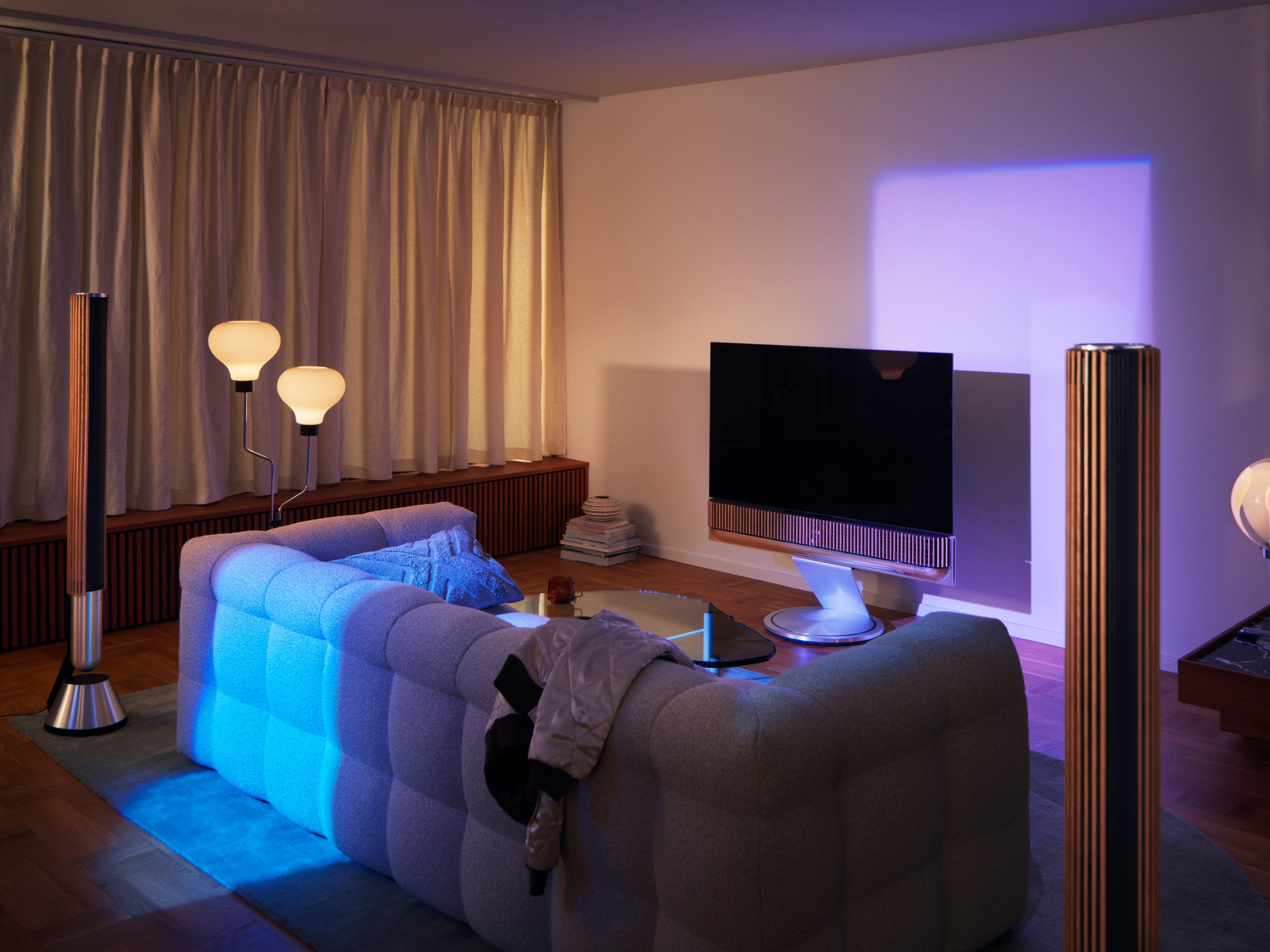
Luxuriöses Bang & Olufsen Heimkino-Setup: Ein Beovision Theatre Fernseher auf einem motorisierten Bodenstandfuß, kombiniert mit zwei Beolab 28 High-End-Säulenlautsprechern mit markanten Eichenholz-Lamellen. Die Szene zeigt ein modernes Wohnzimmer mit atmosphärischer violetter und blauer Beleuchtung, die das skandinavische Design perfekt in Szene setzt.
Wohnzimmer mit Beovision Thetare 65 an der Wand und 4x Beolab 8 als Surroundlautsprecher

The "Sofa Dilemma": Flawless Audio for the Entire Family

When a home cinema setup is calibrated strictly for the center of the couch (the "sweet spot"), listeners seated at the outer ends experience an imbalanced soundstage: the nearest surround speaker blares directly into their ear, while central dialogue gets drowned out.

The B&O Acoustic Formula for Group Listening:

  • Virtually advance the center channel: In the B&O App settings (Speaker Distance), simply enter a distance for the center channel that is 30 to 60 cm further away than its actual physical distance. The system will transmit dialogue signals approximately 1 to 2 milliseconds earlier, dramatically enhancing speech intelligibility across all seating positions.
  • Slightly boost center volume: Raise the Speaker Level of the center channel by +1 to +2 dB.
  • Attenuate surrounds: Lower the surround speakers by 3 to 6 dB (or conveniently use the Fader slider in the app).

Phase Compensation & Room Modes: Tight Bass Without Boomy Resonances

When multiple speakers in a room reproduce low frequencies simultaneously, sound waves overlap. Much like ripples on water, they can either cancel each other out (causing bass to disappear) or reinforce one another (creating boomy standing waves / room modes).

  • Phase Compensation
    The digital signal processor (DSP) in the Beosound Theatre calculates continuous correction filters in the background for every connected speaker model. This ensures that all driver diaphragms across the room vibrate in perfect temporal and phase alignment.
  • The Room Mode Formula
    The fundamental frequency of a standing wave in a room can be calculated using the room length L (in meters):

    f = 172/L

    Example: In a 5-meter-long room, a pronounced room mode occurs at 34 Hz (172/5). The Theatre's RoomSense calibration microphone detects this resonance and transmits an inverted correction signal that actively neutralizes the boominess.
Bang & Olufsen BeoSound Theatre als stand alone

Frequently Asked Questions

Do I really need an additional subwoofer with the Beosound Theatre?

In 95% of standard living spaces: No. Two integrated 6.5-inch long-stroke woofers powered by 800 watts deliver deep, punchy bass down to 28 Hz. However, integrating a dedicated subwoofer (such as the Beolab 19) is highly beneficial for crossover offloading: delegating sub-bass frequencies below 120 Hz to a subwoofer relieves the Theatre's internal amplifiers from heavy excursion work. The result is a dramatic increase in clarity, dynamic headroom, and spatial depth for center-channel vocal reproduction and film dialogue.

Can I continue to use my classic Beolab speakers (e.g., Beolab 8000, 6000, or Beolab 5)?

Yes, absolutely. Via the 8 wired PowerLink connections (RJ45), existing B&O speakers can be seamlessly integrated as surround rear channels or additional channels. The digital RoomSense system calibrates the speakers at the listening position, automatically compensating for differences in volume, phase, and time alignment.

Why are some audio sources (like internet radio) much louder than movies on Netflix or Blu-ray?

Feature films are mixed with a very wide dynamic range: dialogue is kept quiet to leave headroom for explosive effects and peak transients. Conversely, pop music and radio streams are heavily compressed and mixed uniformly loud. If you wish to avoid volume jumps when switching sources, simply enable the Compression function in the Listening Modes within the B&O App.

How do I optimize the sound when multiple people are sharing the couch?

If all channels are calibrated strictly to the center of the couch, nearby surround speakers can sound overly loud to people on the edges, while dialogue gets lost. The expert B&O trick: In the app's "Speaker Distance" menu, enter a distance for the center channel that is 30 to 60 cm further away than its physical distance. This triggers the center channel approximately 1 to 2 milliseconds earlier, noticeably improving speech intelligibility across all seats while maintaining balanced surround audio.

Can I also use the Beosound Theatre purely for music streaming?

Absolutely. When the TV is switched off, the soundbar transforms into a fully-fledged Hi-Fi audio system. It supports Apple AirPlay 2, Google Chromecast, Spotify Connect, Tidal Connect, and Bluetooth.

Can I pair classic B&O speakers with modern wireless speakers?

Yes! For instance, you can connect a classic Beolab 8000 via cable to the PowerLink port while wirelessly integrating two modern Beolab 28 speakers via WiSA as front channels. The Theatre seamlessly bridges both worlds.

Rundes Bang & Olufsen Logo (Roundel) mit weißem B&O-Schriftzug auf schwarzem Kreis. Freigestelltes PNG-Format für die Verwendung als Browser-Favicon, Social-Media-Profilbild oder App-Icon im LuxusSound Onlineshop.

An article by: Alexander Deider 
E-Commerce Manager | Berlin 
Bang & Olufsen expert since 2011

My advice after over 15 years of B&O experience: The Beosound Theatre is a technical masterpiece. Do not let the plethora of settings intimidate you—the automatic RoomSense calibration tunes the system brilliantly at the touch of a button. Then, leverage our battle-tested practical tips, such as crossover offloading for subwoofers and the center-channel trick for the family, to transform your living room into a benchmark-class concert hall and cinema.